
Are you one of us?
It was 10pm on a Monday and the Ninjas had just struck again.
Silently, stealthily, and armed only with their credit cards, this faceless army emerged out of the shadows, as if summoned by some mystical being (or a well-known Northern comedian with a large social media following).
In their thousands they came, all united by a singular mission – to help a stranger in need to hit their JustGiving crowdfunding target. And then, with their mission complete, they disappeared back in to the night – an overflowing funding pot and a stream of ninja emojis the only signs that they’d ever been there.
🥷
No, this is not some weird fever dream brought on by eating too much leftover Christmas cheese. This is Charity Ninjas – an online community spearheaded by comedian and presenter Jason Manford.
And it’s bloomin’ brilliant.
The premise is simple. At 10pm every Monday and Friday, “Sensei Manford” shares a link to a JustGiving page on the Charity Ninjas Facebook page and asks his followers to donate.
And donate they do. In their thousands:
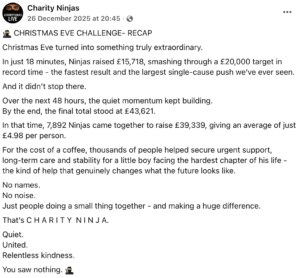
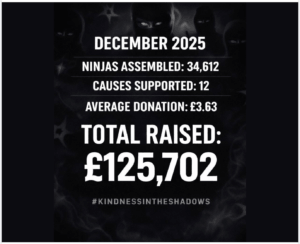
A screenshot of two posts on the Charity Ninjas’ Facebook page, showing the impact over 7,000 people had on Christmas Eve. In total, over 34,000 donations can be attributed to the Charity Ninja movement, raising £125,702 for 12 campaigns.
Of course, celebrities leveraging their fan base to raise money is nothing new. We all know that getting the right person or media channel to champion a campaign can have a massive impact. But what makes this noteworthy, in my opinion, is the way Charity Ninjas has quickly made donating addictive.
These aren’t people humouring or tolerating a one-off ask for support from someone they admire. These are people actively signing up to receive two fundraising asks a week, to causes they have no connection to – and even complaining when those asks don’t materialise!
Think I’m joking? Look at the comments under any post on the Charity Ninjas Facebook page and you’ll find people setting alarms for 9.55pm on the two days to ensure they don’t miss out on taking part.
And, on the few occasions where it’s got to 10:01pm without the link being posted, a tidal wave of anxious comments appears from people desperate for their philanthropy fix.
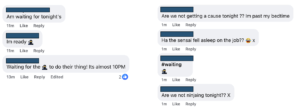
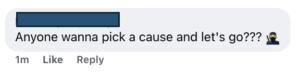
Be honest – when have you ever seen that level of excitement and anticipation for a fundraising campaign? For all the year-end “Last Chance to Give” emails charities send, when was the last time you saw potential donor’s actually panicking that they might have missed the opportunity to support?
This is the fundraising equivalent of the Boxing Day sales. Except rather than queuing up at 6am to get a half price jumper and some cheap socks, these are people falling over themselves to support an unknown person or cause.
So, why has this become addictive?
There are, of course a number of reasons. For example, I could talk about Variable Rewards and Scarcity Bias. The cause is different every time, with no way of knowing who or what you’re going to be supporting until 10pm. Then, once the campaign has hit its target the link and all reference to the campaign disappears without a trace. Both of these can be powerful motivators, and leave a strong sense of FOMO for any aspiring Ninjas who missed the call.*
Or I could talk about the aspirational element of people wanting to feel some sense of connection to someone with celebrity status.
But I think the biggest reason is far simpler than that.
Community.
In a world that feels divided and full of hate, Charity Ninjas gives people the chance to be part of a community united by love and hope. As one Ninja noted, as an antidote to hate, the movement encapsulates “the epitome of human kindness”.
Creating a genuine sense of community can be easier said than done, but when we look closely at the Charity Ninjas model we can see there are a number of ways that sense of community is being strengthened and solidified:
- A clear identity that resonates with the members – it might seem like a small thing, but the simple act of giving members a clear identity they aspire to hold (in this case, Charity Ninja) helps to strengthen the connection to the group. And, let’s face it – when it comes to identity, Charity Ninja sounds a hell of a lot more appealing than “Bronze Member”, right?
- Some Fight Club-esque rules and rituals – each donation ask comes with a set of rules – “No Names, No Noise, No Spotlight”. It’s expected that Ninjas will give anonymously, or simply leave the Ninja emoji as a comment. This leads to a lot of in-jokes in the comments of people pretending nothing has happened. These rituals and shared behaviours help strengthen a sense of belonging, while also separating members from non-members.
- A community of equals – the “No Names, No Noise, No Spotlight” motto also ensures that this remains a community of equals. Nobody gets special praise for donating more. In fact, a lot is made of the fact people are being asked to do “a small thing”, with average donations around the £3-£4 mark. And, when the community succeeds, everybody is entitled to feel good about their role in that success. (Compare that to those charities that still question whether donors giving £3 are worthy of a thank you.)
- Success begets success – people want to be part of success stories. Had the early “missions” not hit their target it would have been easy for momentum to drop. However, the group started by focusing on campaigns with more modest targets. Members could see targets being smashed in short time, helping to recruit new members and building confidence to chase down more ambitious targets.
In fundraising we often talk about the importance of “you” (singular).
But, with people everywhere craving greater unity and togetherness, perhaps 2026 is the year we need to harness the collective ninja power of communities.
Looking for more like this?
If you’d like more ideas, inspiration and insight like this delivered straight to your inbox, why not subscribe to our (semi) regular email, Apollo’s Muse? Simply pop your details in the form below.